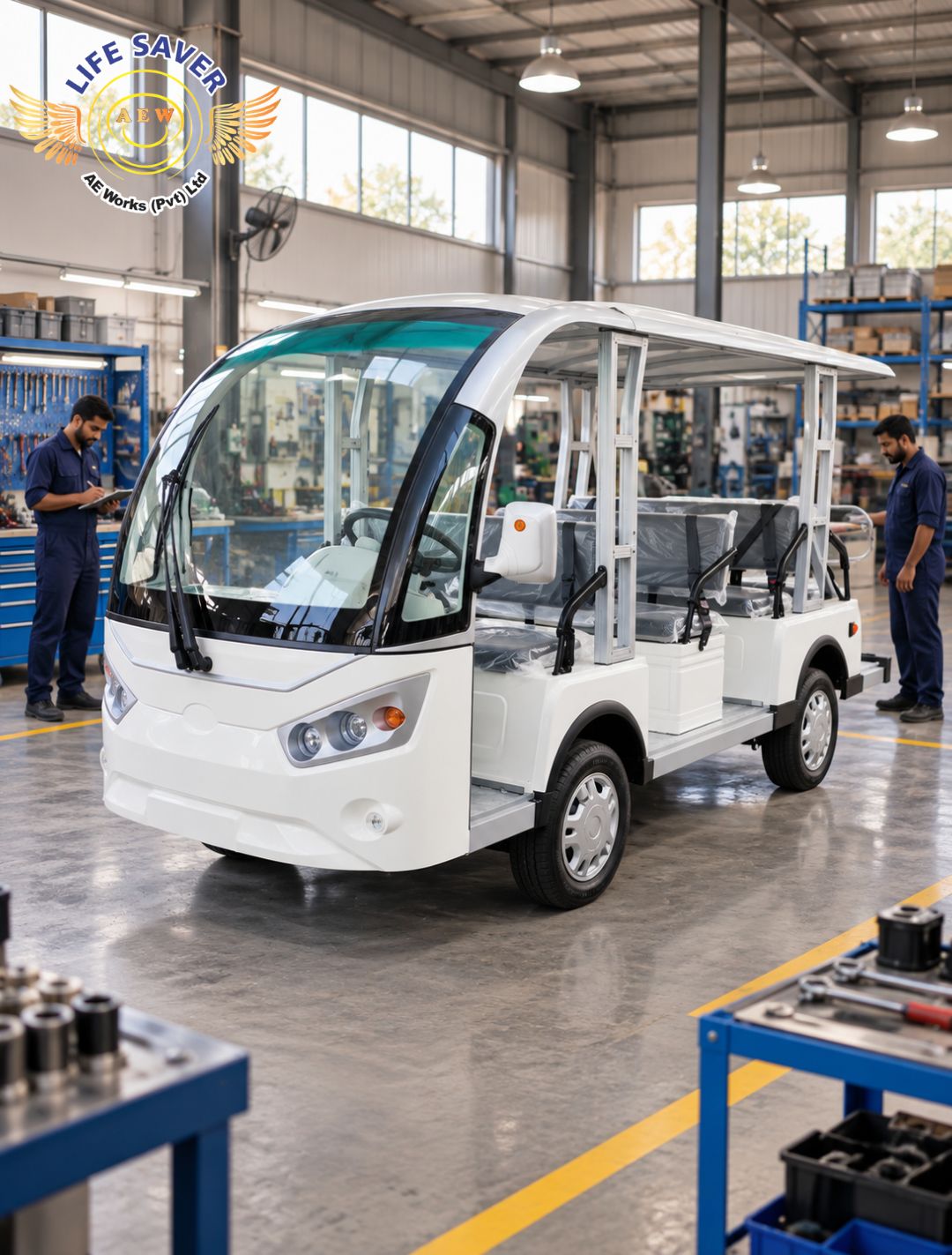
Large campuses in Pakistan often operate like compact cities. Students, teachers, visitors, and support teams travel between gates, hostels, libraries, laboratories, hospitals, and parking areas. A well-planned campus electric cart Pakistan service can make these journeys safer, quieter, and easier to manage.
Modern electric carts also support sustainable mobility when institutions use them correctly. They produce no tailpipe exhaust while operating and create less motor noise than petrol vehicles. However, a successful service still needs safe routes, trained drivers, suitable charging points, realistic passenger planning, and regular maintenance.
What Is a Campus Electric Cart and How Does It Work?
A campus electric cart is a battery-powered passenger vehicle designed for short journeys within a controlled property. Universities may use it between parking areas, teaching blocks, hostels, libraries, medical centres, sports grounds, and administrative offices. It usually travels on planned internal routes at controlled speeds.
The battery supplies electrical energy to a motor through a controller. The motor then drives the wheels. Dashboard instruments may show speed, battery capacity, voltage, operating hours, current, and estimated range. After completing its scheduled duty, the vehicle returns to a designated charging and inspection area.
Electric Cart, Golf Cart, or Electric Shuttle Bus?
People often use these names interchangeably. A smaller golf cart usually carries a few passengers on flexible routes. A campus shuttle handles larger groups through scheduled loops. AE Works currently displays electric shuttle buses with capacities from eight to twenty-three passengers.
| Vehicle type | Common campus purpose | Typical operating style |
| Electric golf cart | Staff, guests, and small groups | Short or on-demand journeys |
| Campus electric cart | Students, staff, and visitors | Fixed or flexible campus routes |
| Electric shuttle bus | Larger passenger groups | Timetabled loops during busy periods |
| Utility electric cart | Equipment and maintenance supplies | Operational movement within facilities |
Campus carts normally work best on private or controlled roads. Institutions shouldn’t assume that every configuration can legally operate on public highways. Registration, roadworthiness, insurance, lighting, and other requirements may vary. The buyer should confirm these matters before planning any route outside the campus boundary.
Why Pakistani Campuses Need Smarter Internal Transport
Many Pakistani universities occupy large sites with widely separated buildings. Summer heat can make long walks exhausting. Monsoon rain creates another barrier. Visitors may also struggle to locate distant departments, while injured students and elderly guests may find ordinary campus movement difficult.
Conventional vehicles don’t always solve these problems. Cars require more road and parking space. Petrol engines can create noise and vehicular emissions close to classrooms, libraries, hospitals, and hostels. A planned electric campus shuttle can connect key destinations while keeping major academic areas calmer and more pedestrian-friendly.
Supporting an Accessible Academic Ecosystem
Reliable transport can help elderly visitors, pregnant passengers, injured students, and people with reduced mobility. However, spare seating alone doesn’t create accessibility. Institutions should assess step height, handholds, boarding space, seating layout, route surfaces, driver training, and the passenger’s actual mobility requirements before choosing a vehicle.
This planning also protects the wider academic ecosystem. A university can keep visitor parking near the entrance and use electric shuttles for internal journeys. That approach may reduce unnecessary traffic around teaching blocks while making departments easier to reach.
A Real Campus Example from Pakistan
Beaconhouse National University reports using e-carts, bicycles, staff transport, and a formal carpooling approach within its wider low-carbon mobility programme. BNU also states that electric carts support its efforts to reduce transport-related emissions. These actions show how universities can combine several mobility measures instead of relying on one vehicle type.
The University of Faisalabad also reports campus shuttle services, restricted private-vehicle access, electric scooters, charging infrastructure, and zero-emission vehicles for internal transport. These examples don’t imply any supply relationship with AE Works. They simply show that cleaner campus movement already has practical relevance in Pakistan.
Key Benefits of Electric Carts for Universities and Colleges
Quiet operation creates an immediate advantage. Electric motors make less noise than petrol engines. This feature suits libraries, examination halls, classrooms, medical facilities, and residential areas. Passengers can also communicate more comfortably during short journeys without constant engine vibration.
Battery-powered carts produce no tailpipe exhaust during operation. This can support zero-emission commuting within campus boundaries and reduce direct exposure to fumes near busy entrances. Yet vehicle production, battery manufacturing, and electricity generation still contribute to wider greenhouse gas emissions.
A Balanced Green Mobility Plan
A cart should form one part of a wider green mobility strategy. Safe walking routes should remain available. Bicycle parking should stay secure. Shuttle stops should connect important buildings. A fair carpooling policy can also reduce single-person vehicle journeys to and from campus.
This combination encourages shared low-impact commuting without forcing every traveller into one transport mode. A student may walk a short distance. A cyclist may use a dedicated path. An elderly visitor may need a shuttle. Good planning gives each passenger an appropriate option.
Environmental Value Without Greenwashing
Electric vehicles generally offer lifecycle emission advantages over comparable combustion vehicles, although the result depends on electricity sources, vehicle size, battery production, and total use. The International Energy Agency’s lifecycle analysis stresses that cleaner electricity improves these benefits over time.
A responsible article shouldn’t describe electric transport as completely emission-free. “Zero tailpipe emissions during operation” provides a more accurate description. That distinction builds trust and avoids exaggerated environmental marketing.
“Choose the route before you choose the cart.”
| Campus concern | Conventional vehicle | Electric campus cart |
| Noise near classrooms | Engine and exhaust noise | Lower motor noise |
| Tailpipe exhaust | Produced during operation | None during electric operation |
| Repeated short journeys | Fuel may be used while idling | Suited to controlled stop-start routes |
| Internal road space | Often needs more space | More compact than many road vehicles |
| Routine servicing | Includes engine-related servicing | Focuses on batteries and running systems |
| Campus identity | Depends on vehicle design | Colours and options may be customized |
Electric systems have fewer engine-related service items, but they aren’t maintenance-free. Batteries, brakes, tyres, steering, suspension, lights, wiring, seats, and chargers still need inspection. Reliable performance comes from scheduled care rather than optimistic assumptions.
Essential Safety Features for a Campus Electric Cart
Safe campus transport requires effective brakes, predictable steering, clear visibility, secure seating, and useful dashboard information. AE Works lists hydraulic braking, parking brakes, windshields, mirrors, lighting systems, and battery indicators across relevant shuttle configurations. Final equipment must match the approved model specification.
Campus rules matter equally. Management should define safe speeds, boarding procedures, capacity limits, authorized routes, and driver responsibilities. Marked crossings and visible stops can reduce conflict with pedestrians. Drivers should slow near blind corners, cafeterias, hostels, classrooms, and crowded event areas.
Braking and Driver Visibility
The AE Works SD-8 page lists a four-wheel hydraulic braking system. The 11-seater electric shuttle lists front hydraulic brakes, rear drum brakes, and a parking brake. Buyers should confirm the final arrangement in writing.
AE Works also lists windshields, wipers, side mirrors, interior mirrors, headlights, tail lights, turning lights, brake lights, and fog lights within relevant configurations. These features support driver awareness, especially during rain, evening use, and busy pedestrian movement.
Passenger Protection and Boarding
AE Works lists seat belts among optional equipment on relevant pages. Institutions should request them clearly when required. They should also assess entry steps, handholds, seating layout, roof coverage, aisle space, and weather curtains. A feature shouldn’t be treated as standard unless the final quotation confirms it.
Safe boarding needs a level stopping point. The driver should stop fully before passengers enter or leave. Capacity labels must remain visible. Bags shouldn’t block exits. Elderly passengers and people with mobility limitations may need additional time and assistance.
Daily Safety Inspection
| Inspection area | What should be checked |
| Battery system | Charge level, warning indicators, and visible damage |
| Service brakes | Smooth and even braking response |
| Parking brake | Secure holding while stationary |
| Tyres | Pressure, tread, cuts, and unusual wear |
| Steering | Smooth movement without excessive play |
| Lights | Headlights, indicators, brake lights, and tail lights |
| Mirrors and glass | Clean and undamaged surfaces |
| Passenger area | Clear steps, stable seats, and unobstructed exits |
| Route | Standing water, debris, potholes, or new obstructions |
| Fault record | Every unusual warning, sound, or vibration |
A written inspection log can reveal recurring faults before they cause breakdowns. It also provides evidence that the institution follows a consistent safety process. This matters during admissions, examinations, convocations, and other periods when passenger demand increases sharply.
Which AE Works Electric Cart Is Right for Your Campus?
Passenger capacity matters, but it shouldn’t decide the purchase alone. Route width, slopes, turning space, waiting time, charging availability, weather exposure, operating hours, and passenger demand also influence the correct model. Smaller carts may provide frequent service, while larger shuttles can reduce trips.
AE Works currently shows four electric shuttle sizes: SD-8, 11-seater, SD-14, and SD-23A. The website contains some conflicting range and speed information between category and product descriptions. Therefore, the signed quotation and final technical sheet should take priority over general website summaries.
AE Works Campus Shuttle Comparison
| AE Works model | Listed capacity | Verified website information | Possible campus role |
| SD-8 | 8 passengers | 48–72V AC motor and 80–100 km loaded range | Staff, visitors, and lighter routes |
| 11-Seater Shuttle | 11 passengers | 7.5 kW motor, 30 km/h speed, and 80 km listed range | Medium passenger demand |
| SD-14 | 14 passengers | Website descriptions require final specification confirmation | Busier departmental loops |
| SD-23A | 23 passengers | Website descriptions require final specification confirmation | Higher-volume campus routes |
The possible roles above provide planning guidance only. Final suitability depends on passenger load, road gradients, surface condition, route length, turning radius, battery configuration, and charging schedule.
SD-8 for Smaller Campus Routes
The SD-8 may suit visitor transport, staff movement, guided tours, or quieter campus sections. Its product page lists eight-passenger capacity, lead-acid or lithium battery options, rack-and-pinion steering, MacPherson strut suspension, and four-wheel hydraulic braking.
A smaller vehicle may turn more easily and provide frequent trips. However, it may require additional journeys during class changes. Institutions should compare capacity against waiting time, driver availability, and the busiest expected passenger period.
11-Seater Shuttle for Medium Demand
The 11-seater model provides a middle capacity for parking-to-department loops, visitor transport, or regular staff movement. Its page lists an AC 48–72V 7.5 kW motor, a 48V 25A onboard charger, a 30 km/h maximum speed, and an 80 km maximum travelling range.
These numbers shouldn’t become an automatic operating schedule. Load, gradients, weather, battery age, and stopping frequency can reduce practical range. The institution should request range assumptions for the exact quoted configuration.
SD-14 and SD-23A for Larger Passenger Loads
The SD-14 and SD-23A offer fourteen-seat and twenty-three-seat options for heavier passenger demand. AE Works presents them for larger facilities and institutional transport. However, some category and model descriptions contain inconsistent figures. Buyers should request one final specification sheet before comparing performance.
Larger capacity can reduce the number of journeys, but it may also require wider roads and more turning room. Route geometry should be measured before procurement. A high-capacity vehicle adds little value when it can’t safely enter the busiest campus areas.
Battery, Range and Charging for Campus Operations
A listed range represents a reference figure, not a guaranteed daily distance. Passenger load, road slope, tyre pressure, battery condition, heat, frequent stopping, and driving style can affect energy use. Lights, heating, audio systems, and other electrical accessories may also reduce usable battery capacity.
Campus managers should calculate expected daily distance and then add repositioning travel and a reserve. Operating close to the theoretical maximum every day increases disruption risk. The cart needs enough remaining energy for delays, route changes, and unexpected passenger requests.
Estimating Daily Range
| Example route calculation | Distance |
| Complete campus loop | 3 km |
| Planned daily loops | 12 |
| Main route distance | 36 km |
| Depot and repositioning travel | 4 km |
| Planned daily movement | 40 km |
| Operating reserve | Add before approving the schedule |
An 80 km listed range doesn’t mean the institution should schedule exactly 80 km. Test conditions may differ from campus operation. A conservative schedule gives drivers time to return safely before charge levels become critical.
Lead-Acid and Lithium Batteries
AE Works lists lead-acid and lithium battery choices on several relevant shuttle pages. Each option can differ in cost, weight, charging behaviour, replacement availability, and expected service life. The buyer should request written battery voltage, capacity, chemistry, charger details, warranty, and replacement costs.
| Decision area | Lead-acid consideration | Lithium consideration |
| Initial cost | May involve a lower initial price | May involve higher initial spending |
| Weight | Usually heavier | Often lighter for comparable usable energy |
| Charging | Depends on charger and battery design | Requires a compatible charger and protection system |
| Replacement | Confirm complete battery-set cost | Confirm pack or module replacement terms |
| Maintenance | Still requires inspection | Battery management and electronics need checks |
| Warranty | Must appear in writing | Must appear in writing |
No battery should be selected through marketing claims alone. A cheaper system may cost more when replacements remain difficult to source. A technically suitable battery should match the route, passenger demand, charging time, climate, warranty, and available support.
Safe Campus Charging
Charging areas should sit away from crowded pedestrian routes. They need appropriate wiring, protection devices, weather shelter, cable management, drainage, and restricted access. The charger must match the battery. Temporary extensions and improvised connections can create electrical and fire hazards.
Charging should also follow the campus timetable. Night charging may suit daytime operation. A split schedule may need charging during quieter periods. Institutions should prepare a backup plan so one charger fault doesn’t stop the complete fleet.
Customizing an Electric Cart for Pakistani Campuses
Pakistan’s climate varies greatly. Karachi brings heat, humidity, and coastal exposure. Lahore faces intense summers and seasonal smog. Islamabad receives heavier rain and cooler winters. Northern campuses may include steeper routes and colder temperatures. Vehicle configuration should reflect these real operating conditions.
AE Works lists customized colours, roof choices, weather curtains, sunshade curtains, seat belts, loudspeakers, solar-panel options, aluminium wheels, and other equipment. Availability can differ by model. Every required item should appear in the signed quotation and approved technical specification.
Weather Protection and Climate Planning
Strong climate-resilient planning considers heat, rain, dust, wind, drainage, and winter conditions. A covered roof can provide shade. Weather curtains may protect passengers during rain. However, enclosed designs also need adequate ventilation during Pakistan’s hotter months.
Charging shelters, drainage, safe wiring, and protected parking form part of low-emission infrastructure. A cart left in standing water or constant direct sunlight may experience avoidable wear. Suitable facilities protect both the vehicle and the people operating it.
Branding and Passenger Information
| Customization | Practical purpose |
| Campus colours | Creates a recognizable institutional identity |
| Route number | Helps passengers identify the correct service |
| Department name | Supports dedicated departmental routes |
| Weather curtains | Adds wind and rain protection |
| Sunshade curtains | Supports passenger comfort in hot weather |
| Seat belts | Adds restraint when included in the specification |
| Loudspeaker | Supports tours and public announcements |
| Reflective markings | Improves recognition in lower light |
| Capacity label | Communicates safe passenger limits |
Branding should never cover lights, mirrors, windows, or safety information. Braking, visibility, safe entry, battery suitability, and steering matter more than appearance. Once those essentials are correct, colour and route branding can create a professional campus service.
Creating a Low-Emission Academic Ecosystem
A cart alone can’t create a low-emission academic ecosystem. Institutions also need shaded walkways, safe crossings, bicycle parking, controlled vehicle access, and non-motorized commuting options. These sustainable practices reserve powered transport for journeys where it adds genuine value.
This balanced approach supports environmental sustainability and practical climate action. Students see organized stops, cleaner internal transport, protected walkways, and responsible charging. The result becomes a working sustainability programme rather than a single vehicle displayed for publicity.
How to Plan Campus Routes and Fleet Size
Route planning should begin with observation. Campus managers should count passengers during morning arrivals, class changes, lunch breaks, evening departures, examinations, admissions, and major events. They should also record road width, slopes, waiting times, walking distances, and turning areas.
Total enrolment alone provides a poor fleet estimate. A university may have thousands of students, but only a smaller group may need transport each hour. Another campus may experience sharp demand immediately after lectures. Fleet size should follow measured passenger movement rather than total population.
Illustrative Route Plan
| Stop | Main passenger need |
| Main gate | Visitors and public-transport arrivals |
| Parking area | Students and staff leaving private vehicles |
| Administration | Guests, employees, and official visitors |
| Academic blocks | High demand during class changes |
| Library | Regular daytime movement |
| Hostels | Morning and evening peaks |
| Medical centre | Priority and accessibility needs |
| Charging depot | Inspection, parking, and charging |
Short loops often provide better frequency than one long route. Large campuses may use separate routes for academic and residential areas. A central transfer point can connect them without sending every vehicle through the complete campus.
Illustrative Fleet Case Study
Consider a hypothetical university where 72 passengers need transport during one peak hour. An 11-seater cart may provide ten usable seats after applying operating rules. If one round trip takes twenty minutes, one vehicle completes about three trips per hour.
| Planning factor | Illustrative figure |
| Peak passenger demand | 72 passengers |
| Usable seats per trip | 10 |
| Required loaded trips | 8 |
| Round-trip duration | 20 minutes |
| Trips per vehicle hourly | 3 |
| Mathematical minimum | 3 vehicles |
| Backup requirement | Assess separately |
Three vehicles may meet the basic calculation, but delays, charging, maintenance, driver breaks, and uneven queues can change the requirement. A backup unit may protect service during examinations or events. This example guides planning and doesn’t represent a fixed purchasing recommendation.
Connecting Different Travel Modes
A good campus system doesn’t place every passenger in a cart. Walking and cycling should remain convenient for short journeys. Shuttles can serve longer routes and passengers who need assistance. This mix supports sustainable mobility without creating new cart congestion.
Students arriving by bus can transfer near the main gate. Cyclists need secure parking near central stops. Visitors need clear route signs. These connections can reduce the campus carbon footprint while making everyday travel more predictable.
Cost, Maintenance and Procurement Checklist
The lowest quotation doesn’t always provide the lowest long-term cost. Institutions should assess the vehicle, batteries, charger, wiring, shelter, delivery, safety options, maintenance, tyres, replacement parts, training, and downtime. Battery replacement can become a major ownership cost if the original proposal doesn’t explain it.
AE Works doesn’t publish one fixed price for every campus configuration. A reliable campus electric cart price Pakistan figure therefore requires a model-specific quotation. Capacity, battery type, safety equipment, roof design, weather protection, branding, charger requirements, and delivery location may affect the final price.
Understanding Total Ownership Cost
| Cost category | Information to confirm |
| Vehicle | Model, capacity, motor, controller, and body |
| Battery | Chemistry, capacity, warranty, and replacement price |
| Charger | Rating, compatibility, and electrical requirements |
| Safety | Brakes, belts, lights, mirrors, and boarding features |
| Customization | Roof, curtains, colours, branding, and accessories |
| Infrastructure | Wiring, shelter, drainage, and parking |
| Maintenance | Service schedule and responsible party |
| Wear items | Tyres, brakes, suspension parts, lights, and wipers |
| Delivery | Transport, inspection, and commissioning |
| Documentation | Warranty, manuals, drawings, and final specification |
No responsible supplier or article should promise a fixed saving without route and energy data. Universities should compare current fuel, servicing, staffing, and downtime costs against the proposed electric service over several years.
Government Policy and Subsidy Considerations
Pakistan’s New Energy Vehicles Policy 2025–30 supports broader electric-vehicle adoption. However, no dedicated nationwide subsidy specifically for university campus carts was identified in the official policy material reviewed. Institutions should confirm vehicle-category eligibility before building incentives into a budget.
Procurement teams should also confirm tax treatment, registration requirements, charger standards, and any provincial rules. Policy support can change, so a current written answer from the relevant authority remains stronger than relying on an old article or dealer statement.
Measuring Results After Purchase
Institutions can measure campus carbon footprint changes by recording electricity use, route kilometres, passenger journeys, replaced petrol trips, and charging sources. This data shows whether the cart replaces higher-emission travel or simply creates additional movement.
The same records can guide future improvements. High demand may justify another shuttle. Low demand may require a shorter route or smaller vehicle. Measurement turns the purchase into an evolving green mobility plan rather than a one-time decision.
Readers can also review AE Works’ broader guide to an electric golf cart for sale in Pakistan. However, final technical decisions should rely on current model pages, route assessments, and a signed specification.
Conclusion
A successful campus electric cart Pakistan project begins with a real transport need. It shouldn’t begin with appearance alone. Passenger demand, route distance, road width, gradients, safety, climate, charging access, turning space, and maintenance determine whether the service will perform well.
AE Works currently displays eight-, eleven-, fourteen-, and twenty-three-passenger electric shuttle options. Institutions should compare current product information and request written confirmation where website figures differ. Capacity should follow measured demand instead of guesswork.
A carefully managed service supports zero-emission commuting at the point of use. It can reduce direct exhaust exposure, noise, and unnecessary internal car movement. The best results come when shuttles work alongside walking, cycling, parking controls, and responsible battery management.
Together, these measures support climate-resilient planning, climate action, and lasting environmental sustainability. They also help create a safer low-emission academic ecosystem built around people rather than vehicles.
Universities can share their route length, passenger demand, operating hours, gradients, climate requirements, and charging access through the AE Works contact page. A route-based technical discussion provides a stronger starting point than selecting a cart through seating capacity alone.
Frequently Asked Questions
What are electric carts used for on university campuses in Pakistan?
Electric carts move students, staff, guests, and visitors between gates, parking areas, departments, hostels, libraries, hospitals, and event venues. They work best on controlled internal routes.
How much does an electric cart or shuttle cost in Pakistan?
The price depends on passenger capacity, battery type, motor, roof, safety equipment, branding, charger, and delivery requirements. AE Works doesn’t display one confirmed price for every campus configuration, so buyers should request a written quotation.
Are government subsidies available for university campus carts?
Pakistan has a national policy supporting broader NEV adoption, but no dedicated nationwide university campus-cart subsidy was identified in the official material reviewed. Eligibility should be confirmed for the specific vehicle category.
Which universities in Pakistan have introduced electric campus transport?
Beaconhouse National University reports e-carts and bicycles within its low-carbon mobility programme. The University of Faisalabad reports campus shuttles, zero-emission vehicles, electric scooters, and charging infrastructure.
What are the main benefits of campus electric carts?
They offer quieter internal travel, no tailpipe exhaust during operation, controlled passenger movement, and easier access across large properties. They can also support a broader sustainability programme when combined with walking, cycling, and shared transport.