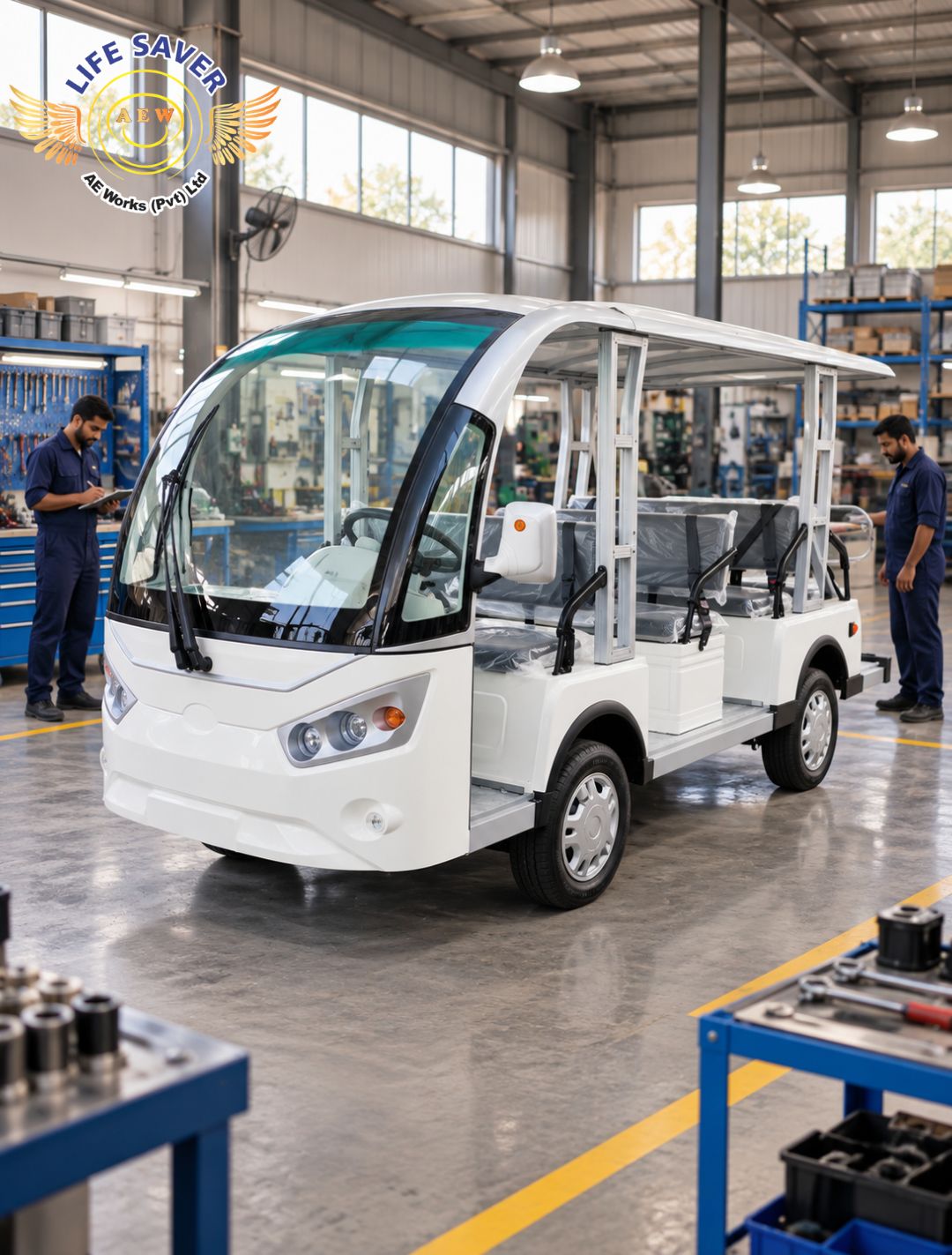
Every morning, Pakistan’s campuses, factories, and resorts face the same transport puzzle: too many passengers and too little time. An effective EV fleet solutions Pakistan strategy starts with a shuttle that matches your route, not a flashy range claim. AE Works lists electric shuttle buses with 8, 11, 14, and 23 seats for different group sizes. Still, buying vehicles is only half the job. You must plan fleet operations, safe stops, fleet EV charging, and realistic ownership costs.
This guide compares published models, explains simple capacity calculations, and shows how to brief a supplier. You'll discover what to verify before ordering your vehicles, without imaginary features or savings promises.
What Are EV Fleet Solutions in Pakistan?
A practical EV fleet is more than a row of battery-powered vehicles. It connects passenger demand, vehicle selection, drivers, routes, charging, and maintenance into one working system. For institutions with predictable journeys, electric shuttles can make internal transport quieter and eliminate tailpipe exhaust along passenger routes. The real goal is dependable service.
For AE Works customers, the relevant products are electric passenger shuttle buses, not electric cargo trucks or universal public chargers. The company lists four shuttle capacities. Specialist charging management software and telematics may be useful elsewhere, but its product listings do not establish that these services are included with a vehicle.
Who Can Benefit From an Electric Shuttle Fleet?
A university can connect hostels with teaching blocks, while a factory can move workers from parking to production gates. Resorts and housing societies face similar demands. For university-specific context, read the campus electric cart guide. These journeys often suit short, repeatable loops. However, each buyer must confirm private-road conditions and legal permission before using a shuttle on public roads.
Why Pakistan's Passenger Fleets Need a Different Plan
Congestion at a gate can frustrate fifty people faster than an empty shuttle can impress them. Busy pickups demand enough seats, sensible departure times, and safe boarding. Meanwhile, summer heat, monsoon rain, road gradients, and electricity interruptions can change daily performance. Good fleet availability begins with a route plan that anticipates these realities.
Electric transport also deserves realistic environmental claims. Battery shuttles produce no exhaust at the point of use and generally have quieter drivetrains. Yet electricity generation, manufacturing, and battery disposal still have impacts. Pakistan's New Energy Vehicles Policy 2025–30 supports adoption without automatically making every private shuttle eligible for incentives. For broader context, see eco-friendly transport in Pakistan.
AE Works Electric Shuttle Models: Compare Real Products
Seats tell only part of the story. The SD-8 suits smaller groups, while the 11-seater shuttle offers intermediate capacity. The SD-14 and SD-23A accommodate larger passenger groups. AE Works publishes different motor and range figures for these configurations, so compare individual product specifications.
The table below uses the detailed model listings rather than the category page's uniform range summary. Published range is not a promise under every temperature, battery age, gradient, or loading condition. Before placing an order for multiple fleet vehicles, request a dated technical sheet confirming exact batteries, equipment, warranty, and delivered configuration.
| Listed model | Passenger capacity | Published range | Published motor |
| SD-8 | 8 | 80–100 km, loaded | 48–72V AC |
| 11-seater | 11 | Up to 80 km | 48–72V AC, 7.5 kW |
| SD-14 | 14 | Up to 80 km | 72V, 7.5 kW |
| SD-23A | 23 | 100–200 km | 72–96V AC |
Which Shuttle Fits a Factory, Campus, or Resort?
The best vehicle fits both passengers and pathways. A small shuttle may handle narrow internal roads with more frequent departures. A 23-seater can reduce the number of loaded trips when geometry permits. Check turning areas, kerbs, speed limits, slopes, pedestrian crossings, boarding step height, and luggage needs. Hospitality buyers can explore resort-specific cart planning.
Calculate Passenger Demand Before Buying a Fleet
Start with the busiest hour rather than daily averages. Count people at each pickup point, measure round-trip distance, and time a real journey with boarding included. These figures define the service cycle. For this reason, fleet operators should also record one-way demand because a full outbound trip may return almost empty. That difference affects operating efficiency.
Consider a hypothetical two-kilometre trip each way. At an illustrative average speed of 15 km/h, the four-kilometre round trip needs sixteen driving minutes. Add four minutes for boarding and turning. One shuttle could then complete three cycles each hour, provided no queues, gradients, or delays interfere. Actual results require an onsite trial.
A Worked Peak-Hour Fleet Capacity Example
Suppose eighty workers need outbound transport within one hour. At three departures per shuttle and 80% average seat occupancy, an 11-seater carries about twenty-six people hourly. That suggests four 11-seaters. A 23-seater moves about fifty-five under the same assumptions, suggesting two. These are planning estimates, not measured AE Works performance.
| Example input | 11-seater | 23-seater |
| Seats per departure | 11 | 23 |
| Departures per vehicle-hour, assumed | 3 | 3 |
| Average seat occupancy, assumed | 80% | 80% |
| Estimated passengers per vehicle-hour | 26.4 | 55.2 |
| Vehicles for 80 passengers/hour | 4 | 2 |
Battery Range, Weather, and Route Reliability
A catalogue figure describes a configuration under conditions that may differ from yours. Full passenger loads, inclines, repeated acceleration, heat, and battery ageing can all change usable range. The SD-8 lists 80–100 kilometres when loaded, while individual pages state eighty kilometres for the 11- and 14-seaters. These numbers need local verification.
Battery chemistry deserves equal attention. AE Works lists maintenance-free lead-acid or lithium choices for selected shuttles. The SD-14 detailed sheet specifies a twelve-unit, 6V/200Ah lead-acid arrangement. However, nominal capacity alone doesn't establish usable energy or battery life. Ask for warranty terms, replacement pricing, temperature guidance, and support and maintenance conditions in writing.
Build a Reserve Into Every Shuttle Schedule
A vehicle rated for eighty kilometres shouldn't automatically receive an eighty-kilometre duty roster. Unexpected journeys, battery degradation, detours, and uneven charging can reduce the remaining margin. Establish a range reserve from monitored, loaded trial runs. Record the battery indicator at departure and return, then adjust the route before promising fixed service frequency.
EV Fleet Charging Infrastructure: Match the Vehicle First
Building EV charging infrastructure begins with the actual electrical architecture of each shuttle. The 11-seater listing mentions a 48V/25A onboard charger, while the SD-14 lists 72V/25A. Those figures are not interchangeable. Safe electric vehicle charging starts with the supplied battery pack, compatible equipment, electrical protections, and a qualified installer rather than a generic public charging advertisement.
Don't assume high-power DC charging works with every low-voltage shuttle. Public passenger-car connectors and DC voltage ranges can differ significantly. Confirm EV charger compatibility with the supplier, then have an electrician assess supply capacity, cable protection, grounding, weather exposure, and parking access. AE Works' catalog does not establish that nationwide charger installation comes bundled.
Depot Charging, Power Outages, and Electrical Safety
For predictable routes, centralised depot charging can make daily inspections and overnight parking easier. A proper site assessment should cover vehicle count, electrical load, flood exposure, ventilation where required, and access for maintenance. Arrange installation and commissioning through qualified personnel. Check applicable NEECA charging rules before developing regulated charging infrastructure.
Manage Vehicle Downtime and Fleet Energy Every Day
A shuttle that isn't ready at pickup time has little commercial value. Track vehicle downtime, cancelled departures, passenger counts, kilometres, and charging interruptions. A daily log can expose weak points before they become chronic failures. Schedule tyre checks, brake inspections, wiring reviews, and safe battery maintenance alongside the normal passenger timetable.
Larger fleets may benefit from charge monitoring, energy management, and a specialist dispatch platform. Still, don't budget for vehicle-to-software integration until compatibility is proven. Establish charging schedules that protect peak passenger service, then assign responsibility for each vehicle's end-of-shift check. A reliable manual system beats an expensive dashboard nobody maintains.
A Simple Fleet Operations Scorecard
Use five numbers at the end of each week: completed departures, missed departures, average passengers per departure, energy drawn from the meter, and hours unavailable for maintenance. These measures reveal fleet operations performance without pretending every shuttle has telematics. As demand grows, use the same evidence to plan scalable infrastructure and backup capacity.
Safety, Passenger Comfort, and Useful Customization
Quiet movement doesn't replace safety discipline. Inspect brakes, tyres, steering, lights, mirrors, handholds, and parking procedures before each shift. The SD-8 lists four-wheel hydraulic brakes and rack-and-pinion steering. The 11- and 14-seater listings describe front hydraulic braking, rear drum brakes, and parking brakes. Confirm the delivered equipment rather than assuming every model matches.
Heat protection matters at Lahore factory gates and Karachi hospitality properties. AE Works lists optional weather curtains, sunshades, colour choices, and certain seating or entertainment features. Some listings mention seat belts as an option, not universal standard equipment. Ask about wheelchair boarding and secure mobility access separately; passenger capacity alone doesn't prove accessibility or public-road approval.
EV Fleet Solutions Pakistan: Understand the Real Costs
Electricity is only one part of fleet ownership. Include vehicle purchase, site wiring, chargers, battery replacement, tyres, labour, insurance, spare parts, and lost service time. These define total operating costs more accurately than an isolated cost-per-kilometre claim. Compare equivalent passenger service against the current vehicle before concluding that electrification saves money.
Here is a transparent example, not an AE Works performance estimate. Suppose one shuttle draws fifteen kilowatt-hours from the meter daily, operates twenty-six days, and pays an illustrative PKR 55 per unit. Monthly electricity spending becomes PKR 21,450. If it provides 100 passenger-trips daily, electricity alone costs PKR 8.25 per passenger-trip.
| Illustrative cost input | Example value |
| Metered electricity per day | 15 kWh |
| Working days per month | 26 |
| Assumed electricity rate | PKR 55/kWh |
| Monthly metered energy | 390 kWh |
| Monthly electricity cost | PKR 21,450 |
| Electricity per passenger-trip | PKR 8.25 |
What Should a Fleet Quotation Include?
Request the exact model, passenger count, battery chemistry, charger specifications, accessories, delivery terms, warranty limits, and available parts support. Ask who handles repairs and how long common replacements take. If separate fleet charging systems are required, obtain their installation quotation independently. Never treat a sample electricity calculation as a complete purchase price.
Plan a Pilot, Follow Pakistan's Rules, and Scale Carefully
Begin with one route and a measurable trial period. Monitor boarding times, actual loaded range, electrical use, driver feedback, and reliable charging access. A pilot exposes practical issues before a larger order. You can also decide whether scheduled charging fits existing shifts or whether another vehicle must cover the charging window.
Pakistan's New Energy Vehicles Policy 2025–30 provides national direction, not blanket permission for every shuttle to use public roads. Confirm registration, insurance, route restrictions, and applicable provincial rules with relevant authorities. For a project-specific vehicle discussion, contact AE Works and share passenger demand, route maps, site conditions, and charging access.
Turn a Route Survey Into a Better Supplier Brief
Useful enquiries include the busiest passenger hour, kilometres per day, road width, gradients, opening hours, and available power connection. Ask the supplier to explain fleet depots planning assumptions where relevant and provide written battery and charging details. AE Works also explains related electric utility vehicle fabrication considerations. The result is a clear request for quotation instead of a vague demand for the cheapest electric shuttle.
A dependable EV fleet solutions Pakistan plan doesn't begin with the largest battery or the boldest advertisement. It begins with people who need to arrive on time. Match AE Works' listed shuttle sizes to verified routes, calculate peak demand honestly, and confirm charging and safety before scaling your fleet.
Frequently Asked Questions
What are EV fleet solutions in Pakistan?
They combine electric vehicles with routes, charging arrangements, drivers, maintenance, and operating schedules. AE Works lists electric passenger shuttles suited to planned group transport.
Which AE Works electric shuttles can a business compare?
AE Works currently lists 8-, 11-, 14-, and 23-seater shuttles. Verify each model's final battery, safety equipment, range, and price in writing.
How much does an electric shuttle fleet cost in Pakistan?
There is no reliable one-price answer. Vehicle configuration, battery choice, infrastructure, staff, upkeep, and downtime determine total cost; request a specific quotation.
Can these shuttle buses use any public EV fast charger?
No. Low-voltage shuttle batteries and onboard chargers may not match public DC charging stations. Always confirm the connector, voltage, and approved equipment.
Are electric shuttles suitable for universities and factories?
They can suit controlled routes with repeatable passenger demand and safe charging. Assess loaded range, road geometry, peak capacity, and legal operating conditions first.